
All Posts By

Angela Korra'ti

Movies

Language and Star Wars geekery in the same post!

I finally did cave and buy A New Hope and The Empire Strikes Back in digital form. They’re the Special Editions–but the lure of being able to watch them both in French was too great to resist. And now that I’ve watched the first of the two, here are my immediate reactions!

First, and this may seem like stating the obvious but I’m going to say it anyway: French sounds different than English. What I actually mean by that in this case is that inflection patterns are noticeably different–an English speaker and a French speaker, when saying the same word, will put the stresses in different places.

An example of this was any line in which Ben was identified by his full name of “Obi-Wan Kenobi”. An English speaker says “Ken-OH-bee”. A French speaker, or at least the French speakers who did the dubs for this movie, says “Ken-oh-BEE”.

Also–and this was particularly easy to note given that every single line in this movie is emblazoned into my brain, enough that I kept mentally playing the English lines along with the French ones, which was rather distracting–the English dialogue is way more blatant in emotional expression. This had the rather lollertastic result of making Luke sound way less whiny in French than he does in English, for example. Han sounded rather less snide, too.

Second, it was intriguing to see where names were changed and where they weren’t. The two biggest ones I noted were that the name of the planet Alderaan was changed, and I’m pretty damned sure I also heard Han calling Chewie “Chiqo” whenever “Chewie” appears in the English dialogue.

A quick google suggests that apparently the French spelling for Chewie’s nickname is “Chico”. But I don’t know if that’s just because people actually saw it spelled in official translated material or if they were transcribing by ear out of the dub–the subtitles on the digital edition I have, at least when I checked in a couple of places, were ever so conveniently not actually showing Chewie’s name! Meanwhile, French Wikipedia page for Chewie has his full name listed there as “Chiquetabbac”–and from what little exposure I’ve had to French so far, and in particular how French nicknames might work (specifically, for a couple of the members of Le Vent du Nord), that suggests to me that it should be “Chiqo”.

Meanwhile, it was quite interesting to me that they chose to put a -d sound on the end of Alderaan–and in particular, they called it “Aldorande”, according, once again, to French Wikipedia. I’m trying to make a reasonable guess as to why the translators at the time might have elected to do that–perhaps just to make it sound a little more French, since “aa” is not a vowel combination you get in the language. Perhaps also to give the word a bit more distinct a pronunciation, since without an ending -e, that -n would just vanish, so maybe giving it a -d sound on the end made it flow better in the dialogue.

Threepio and Artoo’s names were changed, too, though I couldn’t quite catch what they were changed to while I was actually listening to the dialogue; I had to look it up later. Threepio becomes Z-6PO, and Artoo becomes D2-R2. This strikes me as a likely attempt to get names that got phonetically closer to the original English while still making sense in French.

And of course I have to note that Han also had his name changed! He became “Yan Solo”. Which resulted in this little Photoshop gem by Dejah Leger, poking fun at Yann Falquet of Genticorum! Because Dejah’s just awesome like that.
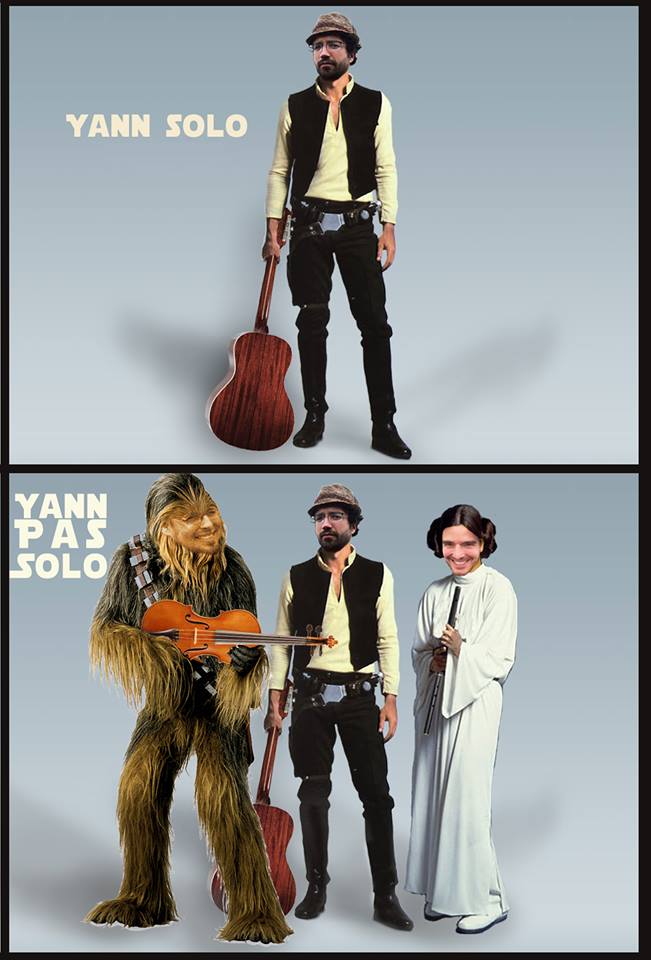
Yann Solo

Yann Solo

The Death Star was “L’Étoile noire”, and the Clone Wars were “La Guerre noire”. Interestingly contradictory to the subtitles in French, which have “L’Étoile de la Mort” and “la Guerres des Clones”. Poking around on Wikipedia suggests to me, from what I can glean out of the French Wikipedia pages, that the translations using “noire” were originally due to trying to sync up with the actors’ mouth motions. I can see “L’Étoile de la Mort” being a problem, with the extra syllables in there.

Vader also had his name changed–Darth Vader became Dark Vador, and my immediate guess there is because -th is NOT a sound they make in French. Also, “Vador” is phonetically closer to “Vader” in English, since the -er syllable in French would come out as a long ‘a’ sound. I know this just from all the various French verbs that end in -er! And I’m also pretty sure I caught Vader being called “Seigneur Vador” by more than one Imperial officer.

Third, my favorite bit that I was able to figure out by ear was Leia’s holographic message to Ben. I was able to catch “Vous êtes mon seul espoir”–although the “Help me” part of that line was actually “Au secours”, NOT “Aidez-moi”, as I was expecting. So the whole line was “Au secours, Obi-Wan Kenobi. Vous êtes mon seul espoir.” Because when you’re making a desperate appeal to a venerable Jedi Knight who fought in the Clone Wars, you’re damn well going to be using “vous”.

By and large I found most of the dialogue too fast to easily follow, even with the help of the subtitles–but I’m pretty sure I caught one bit of French that was NOT in the original English.

In the scene where Vader is reporting to Tarkin that Leia’s resisting his mind probe, the original English line he has is “Her resistance to the mind probe is considerable. It will be some time before we can extract any information from her.” But that second sentence is NOT what Vader says in French. His sentence ends with “maudite princesse”, and I think, but am not a hundred percent sure, that he may be saying something to the effect of “It will not be easy to interrogate that wretched princess”? I hear “parler” in there, and I definitely know “maudite”, because thank you title of the very first Le Vent du Nord album!

All in all: great fun. On to The Empire Strikes Back! I can’t WAIT to try to parse Han’s best scenes with Leia. 😀

Other People's Books

Book review: The Goblin Emperor, by Katherine Addison

The Goblin EmperorThe Goblin Emperor by Katherine Addison

My rating: 4 of 5 stars

If I were to be called upon to provide a single phrase that sums up my reaction to The Goblin Emperor, that would be “a refreshing change of pace”.

There are a host of things I like about this book that fall into that general area. Namely:

  • There isn’t a single human in the story.
  • The goblins are not bad guys, and in fact have a level of social and cultural development apparently comparable to the elves.
  • The protagonist, Maia, is not only not a big brawny action type, he’s instead quite kind-hearted and painfully shy and insecure.
  • Even though Maia is coming out of a history of abuse, which does inform the development of his character, it’s also not a particularly big plot point either.
  • This is not quest fantasy. Nor is it “WE MUST OVERTHROW THIS CORRUPT GOVERNMENT” fantasy or “WE MUST KILL THIS BIG EVIL THING” fantasy (and as a writer who has recently finished a trilogy involving both of those tropes, I am aware of the amusement value of my saying that).
  • We also don’t get into any ideas of “absolute power corrupts absolutely”, either. Maia is thrust without warning into the ruling seat of his people, and yet, he rises to the challenge of dealing with it, and his only real goal is to do as good a job as he can. I really appreciate that.
  • Addison’s taken great care to set up the languages of her society, too–I really rather liked the use of pronouns all over the book, as well as occasional clearly non-English words thrown in here and there to give you a taste of what the languages these elves and goblins are speaking would actually sound like.

At the same time, I hold back slightly from committing to a full five stars. While the language nerd in me really appreciates the effort Addison went to here, I also found the archaic-sounding dialogue a slight hindrance to my ability to immerse myself in the plot. This was not only because of the pronoun usage–all the nobility spoke of themselves in plural form, not just Maia–but also because just about all of the names were polysyllabic tongue-twisters. If you’ve read Tolkien at all, and specifically The Silmarillion, these names may well remind you of the sorts of names Tolkien gave to the ruling dynasty of Numenor, which blurred together after a while–even for me, a devoted Tolkien geek. The Goblin Emperor gives me the same problem.

Similarly, I was a little startled to discover that the vast majority of the action in the book is episodic, one incident after another along the general theme of “Maia has to deal with the next challenge dropped on him now that he’s emperor”. There’s an arc involving investigating what happened to his father and brothers–the act of sabotage that kills them and puts Maia on the throne to begin with–but that’s given surprisingly little emphasis. The story is way more character-driven than it is plot-driven, and while that’s not necessarily a bad thing, it left me feeling like the book should have had more weight to it than it did.

And yet. I’m asking myself if I feel this book’s worthy of a Hugo, and specifically, asking myself whether a Hugo-worthy novel really requires a strong plot arc. Or, is it award-worthy all by itself to have a story that revels in language, and whose protagonist simply just has to figure out how to rule his people to the best of his ability, and to do it wisely and well? Because while Addison doesn’t really shatter any tropes here, she does rather elegantly evade them. And at the end of the day, I really did enjoy this book. Which is what’s important.

Didn’t hurt either that I kept imagining Maia as played by Elijah Wood, either. Four stars.

View all my reviews

Publishing

Public service announcement

Dara points out over here that amongst the Puppy crowd, who cry out for a return to the good old days of science fiction when they didn’t have to be uncomfortable with their reading, a principle complaint is that you literally cannot judge a book by its cover. That they are getting ambushed by SURPRISE GAY! or SURPRISE TRANSGENDER ISSUES! or SURPRISE GENDER EQUALITY! that is not clearly called out on the cover. Dara calls out, quite correctly, that this is supremely hypocritical from a crowd that also points and laughs at the concepts of trigger warnings and safe spaces.

On a related note, on his post Guided by the Beauty of their Weapons, Phillip Sandifer delivers an exquisite smackdown of why this is shockingly ignorant of the history of the genre. Challenging political and religious and social questions have been part of science fiction since its inception, and you can’t exactly ignore this, even if you happen to disagree with the questions that current prominent works are raising.

Me, I’ll just note this for the sake of anybody who might be blindsided by any of my titles. For official reference, books by me contain the following, in no particular order:

Women in positions of power. Who will often talk to each other, about things above and beyond the men in the cast.

Characters of color, often also in positions of power, and who will in fact survive to the end of the book.

Love stories. For values of ‘love story’ meaning that why yes, I’m likely to have primary characters who will in fact fall in love, and who are very likely to actually talk about their feelings with each other like grown-ups do, and who are also very likely to do heroic things for each other in the name of said love. Also, there will be smooching.

Queer people. Who are just as capable as the straight people of having loving, committed relationships, and who will also survive to the end of the story, and who will not be shoehorned into “they’re villains because they’re queer” or “they will become figures of tragedy and lose their loved ones because they’re queer.”

Characters who represent multiple religions and who nevertheless somehow manage to peacefully coexist right out of the gate, or who eventually FIND a way to peacefully coexist after their religious preconceptions have been challenged. When multiple religions are represented in a plot, characters on all sides will be explored.

Persons who find themselves troubled by one or more of these elements in a story are hitherto advised to look elsewhere for their reading.

This concludes today’s public service announcement.

Movies

New trailer for Star Wars: The Force Awakens!

And in the middle of the ongoing Puppy wars, suddenly, with a stirring of the orchestra, we have a Christmas cease-fire gift showered down in glory upon our heads.

Because the new trailer for The Force Awakens has just dropped, and this? THIS IS WHY I GOT INTO SCIENCE FICTION, people. I think the same can be said for a lot of us.

I posted the other day about my dismay that the 20th Century Fox fanfare has been changed in the new digital releases. And one of the things I said in that post was how the music of the Star Wars movies can make me eight years old all over again.

And that just happened, watching this trailer. That opening theme, set off against that magnificent opening shot, just set my heart soaring.

And oh god. Luke’s voiceover. The wrecked Vader helmet. A stormtrooper who’s a character of color–joining hands with–who is this, then? Is she Luke’s daughter? SO MANY QUESTIONS!

And that final shot. Harrison. OH HARRISON. You’re an old dude now, but goddammit, it’s good to see you, sir.

And CHEWIE! A lot of people have been upset that the Expanded Universe novels have been relegated to non-canon status, but y’know what? When those novels killed off Chewbacca is the point at which I stopped reading. Because I couldn’t bear to read that. And now, here’s Chewie right there in the movie, right at Han’s side, where he belongs. :~)

Goddammit, my hopes are now not only up, they’re flying. I still very distinctly remember getting excited over the Phantom Menace trailer. Forty-six-year-old-me is too world-weary to commit completely to getting excited now.

But eight-year-old me, the me who stared in awe at the Star Destroyer that filled the screen when A New Hope came out… eight-year-old me is shrieking with joy. While forty-six-year-old me is smiling, with a shine of tears in her eyes.

“Chewie, we’re home,” indeed. <3 <3 <3

Bring on Christmas. And please oh please oh please oh please don’t let this movie suck.

Publishing

The latest in the Puppy wars

I was telling friends online yesterday, re: George R.R. Martin’s lengthy posts on the Puppy Wars, that I have a lot of sympathy for his cranky-old-man, oh-for-fucks-sake-you-children weariness with the whole affair. If anybody’s entitled to any “IN MY DAY” speeches, it’s definitely Martin. He is the ancient dragon, rousing himself with angry rumbles, to respond to the hordes of gnomes raising a ruckus outside his cave–and he isn’t terribly particular about which gnomes started the fight, or which ones look tastier.

But now even the dragon is wary of the eventual outcome of this debacle, and I have to say, I have a hard time finding any flaws with his reasoning.

I have an equally hard time not being depressed about it, particularly after seeing one of his commenters raging about “romance novels in space” and “bodice-rippers” and “vomit”. Martin, in his dragonish wisdom, roared at him to go away.

But the gnome got his words out anyway. The blow was delivered. And it’s just yet another example of the kinds of blows raining down upon those of us who are getting derided as “social justice warriors”. Women–all too often the ones getting snarled at for writing “romance novels in space” (for definitions of “romance novels” meaning “anything with a woman’s name on the cover, or with a female lead character, or women who serve any function in the story above and beyond being love interest for a man”). Queers and queer allies–getting snarled at for writing “filthy sodomy”, or even just getting angry demands about “why does this particular character have to be gay?! Why is this important to the story?!”, as if having a gay character in the story at all requires special plot-based justification. Writers of color–whose works have to struggle to get filed under SF/F AT ALL. Or writers who are writing non-white protagonists–who find their characters whitewashed on the covers.

And gods help you if you actually match more than one of these categories at the same time.

We’re the ones being accused of “destroying science fiction”. If we say “look, I’m not going to read anything else by person X ever again because of his or her public behavior”, we get sneered at for not being able to separate the art from the artist. And now we’re also the ones being threatened that, should we choose to vote “NO AWARD” on any category in the Hugos this year, that the other pack of gnomes will gleefully destroy that category and make sure that no award is awarded in it ever again.

Look. I can intellectually allow for the possibility that somebody with whom I disagree, politically or religiously, is capable of writing a good book. Maybe even a great one. There are a whole hell of a lot of people who loved Ender’s Game, after all. But that doesn’t mean I’m obligated to actually read that book. You know why?

Because I see exactly zero leeway out of the other pack of gnomes that the same is true for us. All it takes is one pair of women showing affection on camera–even if it’s just holding hands while they walk off into the spirit world–to get them shrieking about destroying a show. All it takes is one important supporting character shown on camera to be gay for no other reason than because the character is gay to get an author challenged on her character decisions. You never see anybody going “but why is this character heterosexual?! Why is this important to the story?!”

In a genre perfectly happy to accept elves, dragons, and aliens, I see none of that other pack of gnomes being willing to stop and go “hey, maybe this story that stars a woman, or a person of color, or a queer person, is still actually a pretty cool story“. Write out swaths of a Star Trek novel in Klingon? Awesome? Put Spanish into it? BLASPHEMY! How is that fair?

I don’t see those other gnomes willing to say that “I like this particular type of SF, and it’s okay if other folks like other types of SF, it’s all good, we’re all fandom.”

Here’s another thing I’m willing to agree to. Even before the Puppies debacle erupted, there has been concern in fandom that the Hugos are not truly representative of all that the genre has to offer. I’ve seen concerns about whether the Hugos belong to Worldcon, or to all of fandom. I’ve seen the Hugos called a popularity contest. All of these are legitimate arguments to make, particularly given that what makes a particular act of creativity “good” is so often a very subjective experience. Sure, there are some objective standards you can use to judge whether a writer is in command of his or her craft–use of language, coherency of plot structure, etc. But you can have novel A and novel B that both show that a writer can meet those objective standards, and you will still have readers with wildly different reactions. And those wildly different reactions are going to still reflect themselves in any awards campaign that builds its list of nominations by polling the opinions of fandom. If that list is coming in from only a tiny subset of fandom, I agree, this is a problem.

I can’t speak for any other gnome in this bloody, rancorous campaign. But as for myself, I agree that there needs to be room at the table for all. Even the gnomes I don’t agree with. These issues about the Hugos are issues that need to be discussed.

But, as I saw Mr. Martin himself point out, there is a big difference between asking for a seat at the table–and overturning the table so nobody else can sit down.

Right now, all the chairs are on fire.

Me, I want a fire extinguisher.

Final note: There have been a lot of developments in the last twenty-four hours on this mess, including Annie Bellet and Marko Kloos backing out of their nominations, and Connie Willis declining to be a presenter. I will be making a point of checking out Bellet and Kloos’s works, particularly Kloos, even though he writes military SF and I don’t normally read that. I will also be bumping Willis further up my To Read queue, to support them all with what had to be extremely difficult decisions.

Meanwhile, Dara has a roundup post of links of interest over here.

Publishing

Thoughts on extremism

As y’all might guess, I’ve been reading a lot on the PuppyGate controversy, including some attempts from moderate voices to call for civil discourse on both sides–and some very justified pointing out that no matter where you are in this particular brouhaha, death threats, harassment, and personal attacks are never acceptable. I would like to emphasize that. I don’t like to think that people on the liberal/progressive end of the spectrum might stoop to such tactics, but I do have to admit to the possibility that such a thing could happen. We are all human, and none of us are immune to the urge to post in anger.

However, there is one point here that I want to address, and that is this: there is no civil discourse, no “agree to disagree”, when one side of an issue is attacking the other side on extremist grounds.

Cases in point:

If you are anti-queer because your religious beliefs dictate that queer people are filthy sodomites, and you actively support or work in favor of legislation that enables discrimination against queer people, there’s no way a pro-queer person can have civil discourse with that. There’s just not. There is nothing polite or civil that a queer person or queer ally can say to someone who not only fervently believes that someone is going to hell because they’re in love with a person the same sex as they are, but who is also prone to associating queer people with pedophilia or incest or bestiality.

If you’re convinced that the only proper response to feminists is to deluge their online presences with rape and death threats, there is nothing polite or civil that a feminist can say in response to that.

If you are convinced that your religion is the One True Religion, and you are dead set on driving anyone who practices some other religion out of your neighborhood, city, or state, there is nothing polite or civil that practitioners of those religions should have to say to you.

If your only answer to people who aren’t the same color as you or who speak the same language you do is to scream at them to go back where they came from or to learn to speak English (or whatever your local language happens to be), sorry, those other people are not obligated to be polite and courteous to you.

Because here’s the thing.

People who are extremists don’t want to hear your dissent. They will dismiss you if you try to be polite about it. If you express your dissent in more forceful terms, you will be attacked. You will be accused of being the real racist/sexist/bigot, even if all you say is “Look, this is wrong and it needs to stop.”

To bring this back around to the whole Puppies issue–in reading a bunch of George R.R. Martin’s posts and quite a few of the comments on them, I’ve been seeing conservative claims that liberal extremists are attacking them. Notably, I’ve seen Martin responding to Correira’s claims that he has been bullied and harassed for his beliefs.

I am not in a position to judge the veracity of Mr. Correira’s claims, and I’m not going to try to do so here. But I will say this. If there are liberal extremists stooping to the same tactics I describe above, then yes, that is wrong and that needs to stop. Likewise, I would also like to express my agreement with Mr. Martin’s own assertion–that if the conservative side of this whole mess really wants to have civil discourse and work towards a resolution, then we need to see some solid action on their part. We need to see some denunciation of racist, sexist, political, ideological, and religious extremism.

For my part, I will say that I very much appreciate my Christian friends who are willing to stand up and say, “No, actually, acts of extremism in the name of Christ are still wrong and you are shaming our religion, stop it.”

Likewise, acts of extremism in the name of defending SF/F–from whatever you think it needs defending from–are also wrong. They are unworthy of the literature of ideas, and they need to stop. Whether you are liberal, conservative, or anywhere in between.

But I must also emphasize–I’m still not going to be cordial, civil, or polite to people who want to deny my right to exist. To have autonomy over who I choose to marry and how I conduct my health choices. To write stories that can be taken seriously, and not dismissed out of hand just because there’s an obviously female name on the cover.

To, in short, kick me out of the clubhouse.

Civility on all sides presupposes that all sides agree that they have the right to be there. Civility means that all sides are willing to support each other’s presences, and that they’re not going to turn around and exult over terrorizing the other side when their backs are turned. Civility means that if you’re called out on doing something bigoted, you don’t automatically lash back and scream, “I’m not the bigot, you’re the bigot.”

And right now, I ain’t holding my breath that this is going to happen.

Publishing

Meanwhile, over in the Puppy pound

Dara’s been keeping a sharp eye on the Hugos brouhaha the past few days. This past Saturday, she put up this report on how certain individuals apparently took it personally that they were being criticized for the behavior of certain other persons in their little coterie. Dara rightly calls this bullshit, because it is–because the Puppies recruited Day into their ranks. And they recruited the GamerGate crowd. And now they’re complaining and claiming that they have no control over the behavior of the “wild wolf” Day.

Sorry, but no. You don’t get to recruit the likes of Day into your ranks and then complain when people call you out on it. It is not only disingenuous, it’s also cowardly.

But of course that wasn’t all, either. Dara’s got another report up this morning, following up on the previous–in which it is declared that people who would vote NO AWARD rather than the Sad Puppies slate are not only assholes, they are also Leninist Communists. (Or Nazis, according to another commenter! So the people the Puppies don’t like are Nazis AND Communists!) Phrases like “cuddly pink fluffy cudgel of political correctness” and “flaming rage nozzles of tolerance” get thrown around. (Because apparently “tolerance” is a dirty word.)

Mr. Torgersen apparently also feels that people who support Chick-Fil-A are “heroes”, and that supporting a corporation known for blatant homophobia is the act of “free people”.

I’ve seen other posts in which larger names in the genre are calling for civility. George R.R. Martin and Mary Robinette Kowal are trying to do their part to fight the fires. Noble efforts on both their parts, and I particularly applaud Kowal for not only being willing to provide people supporting memberships to Worldcon, but specifically also recusing herself from any Hugo nominations next year. Likewise, I applaud those who are matching Kowal’s efforts and trying to broaden the pool of supporting memberships being offered to fans on tight budgets.

I’m all for civility. I’m for the ideal of SFdom being welcoming to all within its ranks. We are supposed to be the literature of ideas, after all, and ideas cannot thrive in an atmosphere of stagnation. We need to have our ideas challenged, and in order to do that, we need diversity in the ranks.

But here’s the thing–when some of those ranks are on record as not wanting women, people of color, or people of alternative sexualities in the clubhouse, when they specifically go out of their way to fight against such persons being included, and when they shriek that all who would stand in their way are Nazis and Communists and “Social Justice Warriors” and “CHORFs” and whatever other derogatory terms they dream up… my civility is spent. So are my tolerance and sympathy.

Politically disagreeing with me is one thing. Going out of your way to fight against my existence is another thing entirely.

Tolerance goes only so far. It presumes that all parties are at least willing to accept each other’s presence in the clubhouse. But this? This is spiteful little boys throwing tantrums that the girls and the black kids and the queer kids are in the clubhouse now too, and they want some of the punch and pie.

And hey. Pie is tasty. But we don’t have to fight over the pie. There is enough for all, people.

But if you want a slice of the pie, stop throwing tantrums. And stop trying to push the other kids back out of the clubhouse. It’s unworthy of children above the age of six, never mind grown men. It’s unworthy of the literature of ideas.

And it needs to stop.

In closing, here, instead of a Sad Puppy, I offer this Happy Kitten instead.

So Happy!

So Happy!