Browsing Category

Quebecois Music

I’m a raving fangirl for Quebecois trad music, now that I’ve discovered many of its fine bands and have gotten involved with a session group to play the tunes. I post about this a whole lot!

Quebecois Music

Quebec band recommendations, round 2: La Volée d’Castors!

I posted back in 2011 about my recommendations for La Volée d’Castors, who remain one of my top favorite Quebec bands even though they’ve more or less gone inactive. Much of what I said in that previous post still holds true!

But since I did that post I did in fact pick up their holiday album, L’album du temps des fêtes, because I am a completist that way. And I have to admit that it was great fun to hear French interpretations of otherwise familiar-sounding holiday songs, as well as some things that weren’t familiar to me at all. And there’s some fun almost 50’s-style vocals on one of the tracks on that album, too, which was particularly surprising in the context of Quebec trad and the holidays.

Also, I must call to your attention this excellent video from 2003, which is of a VDC concert. The band’s in great form here and you’ll hear several of the tracks that appear on the albums VDC and Migration. Look towards the back to spot Réjean Brunet, now of Le Vent du Nord, on the bass!

My previous favorite songs and albums of theirs still stand, but I can also note that it’s come to my attention that three of the gentlemen previously involved with VDC are now involved with a new group, La Cantinière, and they’re about to drop a new album which is available on bandcamp over here. So if you like the vocals in VDC, this should be well worth your attention as well!

Quebecois Music

A guide to Quebec trad for English speakers

Internets, as you all know, I’ve been happily fangirling Quebec traditional music for a couple of years now, and quite a few of you have started to ask me questions about it. And because I like you, Internets, and I want to share with you the musical goodness, I’d like to present for you a Guide to Quebecois Traditional Music for English Speakers!

Q: What is Quebecois traditional music?

A: A very close cousin of Irish/Celtic trad. If you’re a fan of Irish or Scottish music, you’ll probably find Quebec trad very compatible to your tastes; there’s a lot of overlap between the two genres.

Q: What makes Quebec trad differ from Irish/Celtic/Scottish/etc.?

A: Three main differences, which are:

  1. Podorythmie. With most Celtic bands the percussion will usually be handled by a bodhran player, who may double up on shakers or bones. There may or may not be an actual drumkit depending on how far into rock the band in question slants. With a Quebec trad band, though, the percussion is almost always handled by someone who does podorythmie, the rhythmic footwork that’s a big signature sound for the genre.
  2. Call and response. Quebec trad is very heavily structured around call and response, where you’ll have whoever’s singing lead echoed by the rest of the band. Relatedly, you’ll find a great number of Quebec trad songs structured in such a way that the first line of a verse will be called, then responded, and then the verse will finish up with a chorus and then a second line which will then roll over into being the first line of the next verse. (This is a very helpful song structure when you’re a newbie to French and you’re trying to figure out how to sing the words!)

    Now, sure, call and response isn’t unknown in Celtic trad in general–but I’ve seen it be a LOT more common in Quebec trad. It makes the songs highly participatory and that’s one of the big reasons I love singing along to the songs so much.

  3. Turluttes. You’ll find a lot of Quebec trad songs will have a turlutte section, sometimes small, sometimes dominant, and sometimes as the entire song. Turluttes are when you get a singer or group of singers vocalizing a melody that in other traditions might be played with instruments. You’ll also hear this referred to as mouth music or mouth reels, similar to puirt à beul or lilting.

    As the Wikipedia link I’ve pointed at in the previous paragraph calls out, turluttes are built out of a set of specific phonemes–a lot of t and d and l and m sounds. They’re almost always up-tempo and joyous and great, great fun.

    A truly splendid example of turluttes in action can be found sung by Les Charbonniers de l’Enfer right over here, with bonus podorythmie solo in the middle.

Q: How is Quebec music similar to Irish/Scottish/Celtic music?

A: Lots of Quebec trad will be familiar to Celtic music fans just because there’s a rich heritage of tunes, jigs/gigues, reels, etc. There are some fun musical and stylistic differences that instrumentalists will notice–particularly how many Quebec tunes are often played “crooked”, doing interesting things to time signatures and varying up the rhythm. If you’re an instrumentalist you’ll want to listen for that.

Likewise, a lot of the topics of the songs will be familiar to Celtic music fans. Alexander James Adams has been often quoted (in particular by me!) as saying that the three main categories of Celtic music are Whiskey, Sex, and Death. This is also true of Quebec music, although from what I’ve seen in Quebec music, it’s more like Wine, Sex, and Death, with a side helping of Religion. (I’ve noticed quite a few songs involving shenanigans that involve priests, for example. 😉 )

Q: Do I need to be able to speak French to appreciate Quebec trad?

A: No! Certainly no more than you need to be a Irish or Scots Gaelic speaker to appreciate Celtic music, anyway. I find that studying a little bit of French enough to let me get an idea of how Quebec trad lyrics go enhances my appreciation of the songs considerably, but you don’t have to go to the lengths I’m going. A lot of the most active bands in the genre post lyrics to their websites, often in both French and English, and even if they only post the French lyrics that’s enough for you to throw the words through a translation engine.

And there’s fun stuff to be found in the lyrics, too. Plus if you do that, you get to be one of the Anglophones in a Quebec trad concert who can start snickering at all the best bawdy bits of songs!

Also, turluttes are language-agnostic!

Q: Enough overview! Who are some bands or artists I can check out?

The ones I’m most fond of are La Bottine Souriante, La Volée d’Castors, Galant, tu perds ton temps, Les Charbonniers de l’Enfer, Genticorum, De Temps Antan, and especially Le Vent du Nord!

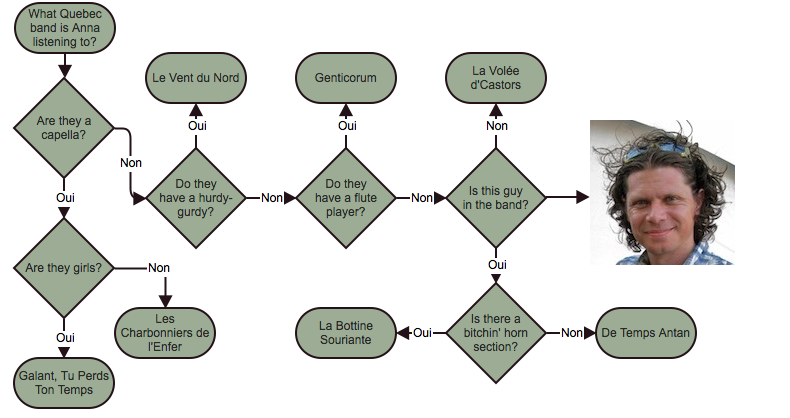
And if you have trouble telling all those names apart, I can direct to you to this handy flowchart I made for that exact problem!
Quebec Band Flowchart

Quebec Band Flowchart

For a nice crossover of Celtic and Quebec fiddle styles, I also highly recommend Celtic Fiddle Festival, who feature André Brunet of De Temps Antan. There are also a couple of excellent albums done by André Marchand and Grey Larsen, specifically on the theme of crossover between Irish and Quebec music, and I recommend those too. You can find them here.

I will update this FAQ with new data as I think of it. I did overviews on my favorite bands a while back but I’ll be posting new ones as well, since several of the bands in question dropped new albums since I originally wrote those posts.

Any questions I haven’t covered here? Shoot ’em at me!

Quebecois Music

And now, to solve an ongoing problem

My belovedest of Daras is at a bit of a loss when it comes to comprehending my rampageous affection for Quebecois traditional music. She doesn’t speak a lick of French, and so I could mention any one of the various bands I’m following, only to have their names just parse to her as “French sounds”. And it didn’t help matters much either when we went up to Harrison Hot Springs this past weekend–because two of the guys in De Temps Antan ARE brothers of guys in Le Vent du Nord, and the sets of brothers in question do look rather alike!

Several of you who read me on a regular basis won’t be having these problem, but in case you’re in the same boat Dara is and find yourself trying to figure out who all these people are I keep enthusiastically babbling about, here. I present for you this handy flowchart for how to tell apart my seven favorite Quebecois traditional bands!

Quebec Band Flowchart

Quebec Band Flowchart

Never let it be said that I am not helpful!

Quebecois Music

Album review: Soyez heureux, by Galant, Tu Perds Ton Temps

Several of my Anglophone friends both online and off who’ve studied French have talked about French is the language of precision. I’ve seen this referenced online as well as a reason for why French gets used in diplomatic negotiations–because it is in fact much clearer than English when it comes to vocabulary. Newbie as I am in my French studies, even I can see this. So far I’m definitely finding that if I want to say a given thing in French, there’s pretty much going to be one and maybe two ways tops to say it.

I mention this because it rolls over into music as well. In music, though, precision is not just a matter of word choice; it’s also a matter of tempo, of rhythm, of melody and counter-melody and harmony. Mind you, suitably trained musicians can do this regardless of what language they speak or sing. My brother the rock drummer, I daresay, might tell you all about how precision is the life’s blood of a percussionist. But in my explorations of Quebecois traditional music, precision is absolutely one of the qualities I’m seeing shining forth. If you want to know why I admire the hell out of instrumentalists who can do podorythmie, it’s exactly because of that–the physical precision and coordination required to do that with any speed at all. And when you throw in the ability to sing at the same time, the precision becomes more than just physical. It becomes a defining factor of the music, and it’s a real big part of what sends me bouncing down the street singing turluttes at the top of my lungs, or seeing if I can in fact get my feet going while playing a reel on one of my flutes.

All of which leads me to the topic of this post: the brand new album by Galant, Tu Perds Ton Temps!

I’ve written before about how Quebec trad is a pretty male-heavy genre of music, and usually I am absolutely fine with that, given how much I’m enjoying all the various bands I follow. Galant, Tu Perds Ton Temps however go a long way to address this gender imbalance and I adore them. For one thing, it’s delightful to try to sing along with French lyrics sung in my actual range. For another, that precision thing? The women of Galant, Tu Perds Ton Temps have it in spades. I am in awe of how their five vocalists can interweave their voices. They may not be as roaringly powerful vocal-wise as the Charbonniers, my other favorite Quebecois a capella group–but every one of their songs is an exquisite, delicate work of musical art. (And when I say delicate, don’t let that make you think they lack energy! I assure you, they don’t!)

Their new album is called Soyez heureux (“Be happy”). It’s their third release, and now that they’ve reached album #3, it’s clear that they’ve gotten their style down and can now spend time polishing it until it shines. Being a newbie to French, I do suffer a considerable handicap in not being able to follow most of the lyrics–but I can tell that vocally and rhythmically, they’ve definitely kicked it up another notch or two from their previous albums. Moreover, from what I’ve read about the album, there is a concerted effort here to tell the stories of women in the various songs. What surprised me the most, too, was one article mentioning at least one song about a lesbian! Which makes me really want to dig into the lyrics and see if I can figure out which song has that story. Because that? That’s an awesome thing to see cropping up in folk music.

The digital booklet that came with the album does not include lyrics for every song, sadly, so I’m going to have to spend some time trying to translate what is there–which appears to be a broad overview of the five women whose stories the songs are telling. But in the meantime I can tell you that the addition of little interludes of violin between several of the tracks give the album an almost classical-sounding structure overall, and I suspect they’re serving as transitional markers between one woman and the next in the story flow.

I don’t know which woman in the group has which voice yet, but I particularly love the deeper voices in the harmony mix; whoever’s got the contralto has a gorgeous voice, in particular. Listen too for the rhythms laid down by their percussionist–that precision thing again! This being the only one of my main Quebec groups that includes a bodhran in their percussion as well as feet adds another unique layer to the band’s sound, and it’s a great rumbly low anchor to their high, sweet vocals.

And I can tell you as well that of the tracks available on the album, my favorites so far are “Laissez-moi faire” (+10 for any song with turlutte rhythms to it!), “Elle attent tout l’temps”, “Virons-la” (because mmmm turluttes in minor mmmmm), “La complainte de Ste-Marie” (for some haunting slow harmonies), “Le blues de la ménagère” (because of sweet waltz tempo), and “Louise et son soldat” (for OH HEY I can actually understand that title, so maybe I’ll be able to pick a story out of the lyrics!).

This album’s been released to US markets, so you can grab it from US iTunes or Amazon. Canadians can grab it from Canadian iTunes or a physical CD from Amazon CA. Archambault in Quebec has it right over here, and Renaud-Bray has it here.

The band can be found on both Facebook and Twitter, as well as at their official website. Go tell ’em bonjour, won’t you? And get their album!

Quebecois Music

Album review double-header: Celtic Fiddle Festival

Being the raving fangirl of Quebec music that I am, I’ve happily identified several skilled musicians who are now well and thoroughly in the category of “I want to purchase every single note these people EVER RECORD EVER”. And very high on this list is André Brunet!

I didn’t know it at the time, but I first discovered André when I saw La Bottine Souriante perform for the first time. And when I brought home the album Rock and Reel, one of the tracks I fell most strongly in love with was “Autumn Sky”–which I know now of course as “Ciel d’Automne”, one of his earlier compositions. These days, he’s one third of the fantastic trio De Temps Antan, who I’ll be scampering off to see perform in Canada in one more month! (Of which there WILL be extensive coverage, O Internets, and as many pictures as possible. With mammoths!)

But only in the last few weeks have I learned that he’s also a member of a quartet called Celtic Fiddle Ensemble. This group just dropped a brand new live album, Live in Brittany. This was reviewed by Hearth Music right over here, and on the strength of that review plus André Brunet, I snapped this album right up. In the process I actually wound up getting an older album of theirs as well, Équinoxe, because Loftus Music’s mail server kept mailing me confirmation mails over and over and they kindly offered me a complimentary CD for the trouble.

(And because the person I spoke with in email was so awesome about giving me that free CD, let me plug their site directly: they’re right over here! Seriously, go check them out and see if they’ve got something you’d like to buy!)

Anyway, survey says re: both albums: if you’re a fan of excellent fiddle, check these guys out. There’s masterful, expressive playing all over every single one of these tracks. You can definitely tell which tunes are Quebecois whenever André kicks in with the podorythmie, which of course pleases me immensely–but there’s plenty of goodness on the non-Quebecois tracks as well. And some of these tunes I actually recognize from hearing them played in session, which gives me, as a newbie session player, a particular little kick of pleasure.

Now, like it says on the tin, these guys specialize in fiddle. But their guitarist is by no means an afterthought. As I’ve come to learn in sessions, you don’t want more than a single guitar backing up the melody players–but this means that whoever’s on guitar has the responsibility to provide suitably skillful accompaniment. Rhythm and tempo must be maintained–and whatever chord line is getting hit, ideally, should be just as interesting to listen to as the melody. So that rhythm needs to not only support the melody, but sometimes provide counterpoint to it as well. And that’s not as easy as it sounds. I’ve tried it.

I was very happy to observe that the group’s guitarist, Nicolas Quémener, is absolutely up to the task of accompanying three master fiddlers. While André, Kevin Burke, and Christian Lemaître are over there laying down the law on their instruments, Nicolas lets fly with return fire on his guitar. You’d think that three fiddles versus one guitar wouldn’t be a fair fight–but with these gentlemen, you’d be wrong.

Équinoxe is an earlier album, dating back to 2008, while Live in Brittany is of course the brand new album. If you pick up both of them, listen to Équinoxe first, just because it’s fun to see how the group progresses from studio album to live concert album, and what happens as they get five more years’ experience between them. If you get just one, get Live in Brittany–but get one! Because wow, these guys can play.

Loftus has the live album right over here in both CD and MP3 form. Ditto for Équinoxe, here. You can find the older album on iTunes as well, and both are on Amazon, but honestly, since Loftus Music’s rep was so awesome to me–buy ’em straight from Loftus. You’ll be glad you did.

Quebecois Music

Album review: Enregistré Live, by Genticorum

And because I’ve managed to go more than five minutes around here without talking about Quebecois music, let’s correct that little problem, shall we? Because my boys of Genticorum have just put out a shiny brand new album, and if you have any interest in Quebecois trad whatsoever…. actually, chances are you already know about this album and you probably even heard about it before I did! But that said, if you’re one of my readers and you’ve seen me enthusing over Quebec trad and you want to check it out for the first time, you could do a hell of a lot worse than picking up Enregistré Live.

When it comes to Quebec trad, okay yeah, I gravitate to the powerhouse bands. Give me Le Vent du Nord and their hurdy-gurdy goodness, or La Bottine Souriante and the sheer unmitigated awesome of their entire horn section. Or the Charbonniers, who pull off the impressive feat of matching La Bottine in power with nothing more than five voices and ten feet. Genticorum is subtler and more deft than these groups in some ways, though, and not just because a flute being one of their primary instruments contributes a certain delicacy of style. This manifests as well in the swift, light podorythmie from fiddler Pascal Gemme, the nimble guitar from Yann Falquet, and the delivery of their vocals.

Did I mention this is Genticorum’s first live album? Since I’ve had the distinct pleasure of seeing them in concert, I was particularly excited about picking this album up. I wanted to see if it captured the energy of the concert I’d previously experienced, and I wasn’t disappointed in the slightest. The between-song intros are minimal, so if you don’t speak French, or if you have enough to follow song lyrics but not stage intros, there won’t be much to interrupt the music for you. (For me, though, I also quite enjoy trying to figure out what the boys are saying about the songs–it’s an excellent way to practice French if, like me, you’re learning!)

Because of course, the songs are the point of the album. There are a couple of tracks here that were familiar to me from the studio albums I’d bought, like the dextrous “La brunante”, where Alexandre de Groisbois-Garand shines on his flute. And the big closer, “La chasse”, is one of my repeat play tracks from their very first album; this is a particularly awesome one since the boys are in high form, and they get the audience going too. The very last track, presumably an encore, was also familiar to me–but because I’d encountered it before on a Galant, Tu Perds Ton Temps album! “La valse turluttée” worked very well by the Galant girls as a complex a capella piece, but it works splendidly here with Alexandre’s flute too.

Of the tracks I didn’t recognize going in, I particularly liked “La finno-gaspésienne”, another deft instrumental; “Déline”, featuring lovely vocals, and especially “La rouillette”, another vocal number, but one which gives each of the boys a chance to sing lead (and Pascal to delightfully milk the hell out of his turn), and which has fun overall structure as a song. (And you can find this one on YouTube! Clickie!)

The album’s not released in the States yet, so right now your options I’m aware of for getting your hands on it are Amazon US, Amazon CA, Archambault in Quebec, Reynaud-Bray in Quebec, and the Canada iTunes store.

But I’d strongly encourage you to keep an eye out on their website for further updates! Or follow them on Twitter or on Facebook. And tell them Anna sent you!

ETA: Bonjour, all you Genticorum fans! Gracious, a lot of you have found this post.

Quebecois Music

Album review: Errance, by Bon Debarras

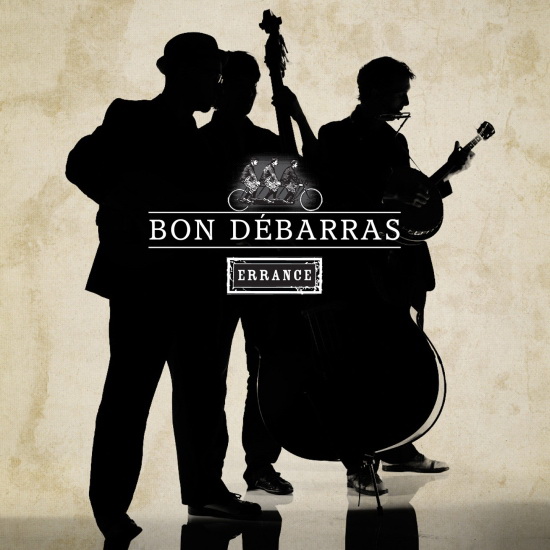
I give an awful lot of fangirling time to Le Vent du Nord, De Temps Antan, and the Charbonniers, it’s true–but there is a lot more to be found in the genre of Quebecois trad, and I’ve got quite a few other groups represented in my collection at this point. One of these is Bon Débarras, who Dara and I had the pleasure of seeing perform at last year’s Festival du Bois. They are a very lively trio, melding American and Quebecois influences to form a distinct sound all their own. It’s very worth seeing them perform live, since Dominic Desrochers is an excellent dancer. But if you can’t pull off getting to a show, their albums are the next best thing!

Errance by Bon Debarras

Errance by Bon Debarras

Their second album Errance has just dropped, and I am delighted to report that I enjoyed the hell out of it. You’ll find those American influences I mentioned all over this album–things like using a washboard for percussion as much as they do the feet. Or their vocal style, which rings very familiar to my Midwest-bred ears despite the lyrics being in French; I hear a lot of echoes of country or bluegrass or rockabilly in their singing. Or the particular mix of instrumentation, particularly banjo and harmonica, which carries the same sort of echoes for me as the vocals.

Track-by-track reactions behind the fold!

Continue Reading